The EURUSD currency pair is one of the most popular and traded pairs in the global currency market. Its rate reflects shifts in economic conditions across the US and the Eurozone. The pair's fluctuations are sensitive to the Fed and the ECB, the inflation rate, and global events.
This article delves into EURUSD forecasts for 2026 and beyond, assessing market sentiment and considering technical and fundamental factors. Read this article to get an answer to the main question: Is it worth investing in this currency pair now?
The article covers the following subjects:
- Major Takeaways
- EURUSD Real-Time Market Status
- Euro/Dollar Weekly Price Forecast as of 31.08.2026
- EURUSD Price Forecast for 2026 Based on Technical Analysis
- Analysts' EURUSD Price Projections for 2027
- Analysts' EURUSD Price Projections for 2028
- Analysts' EURUSD Price Projections for 2029
- Analysts' EURUSD Price Projections for 2030
- Analysts' EURUSD Price Projections until 2050
- EURUSD Market Sentiment on Social Media
- EURUSD Price History
- EURUSD Price Fundamental Analysis
- More Facts About EURUSD
- How We Make Forecasts
- Conclusion: Is EURUSD a Good Investment?
- EURUSD Price Prediction FAQs
Major Takeaways
- The current price of the EURUSD pair is $1.15936 as of 02.09.2026.
- The EURUSD pair reached its all-time high of $1.6039 on 15.07.2008. The pair's all-time low of 0.8227 was recorded on 26.10.2000.
- The pair's trajectory depends on the decisions of the ECB and Fed on interest rates, inflation, GDP growth, and other macroeconomic indicators.
- The asset's volatility increases during economic data publications and geopolitical events.
- It often shows a positive correlation with the GBPUSD pair and a negative correlation with the USDCHF pair.
- Some analysts expect the EURUSD pair to rise to $1.1700 in 2026, while others are more pessimistic and predict a decline to $1.1500–$1.1460.
- By 2027, the euro is projected to strengthen to $1.1780–$1.1800. More conservative predictions suggest the EURUSD pair may fall to $1.0800.
- According to estimates, by 2030, the EURUSD pair will trade within the $1.1400–$1.1900 range. More cautious projections indicate that the pair will drop to $1.0790.
- It is virtually impossible to make a reliable forecast for 2040–2050. During such a long period, the asset is likely to be influenced by geopolitical shifts, technological advancements, and developments in international trade. The pair's performance will also depend on inflation, interest rates, and economic growth rates in the Eurozone and the US.
- EURUSD: According to technical analysis, the euro is correcting lower, targeting the support zone A of 1.1543–1.1526.
EURUSD Real-Time Market Status
The EURUSD currency pair is trading at $1.15936 as of 02.09.2026.
When analyzing the EURUSD pair, it is essential to consider the ECB and Fed decisions regarding interest rates, inflation, and employment in the US and the eurozone. These indicators shape the pair's trajectory. Historical extremes can reveal important technical levels, while technical analysis can help determine optimal entry and exit points.
Indicator | Value |
ECB interest rate | 2.40% |
Fed interest rate | 3.75% |
EU inflation | 2.9% |
US inflation | 3.4% |
All-time high | $1.6039 |
All-time low | $0.8227 |
52-Week Range | $1.1325–1.2079 |
Change over 12 months | -0.73% |
Current trend | Sideways, with a slight bearish bias |
Euro/Dollar Weekly Price Forecast as of 31.08.2026
At the end of last week, the euro entered a downward correction. If the correction continues this week, the price may fall to support A of 1.1543–1.1526. Once this zone is tested, consider long trades, with the first target at 1.1619 and the second one near the August high of 1.1711.
The trend boundary is shifting to 1.1459–1.1434. If the EURUSD pair retreats to this zone, long trades may also be considered.
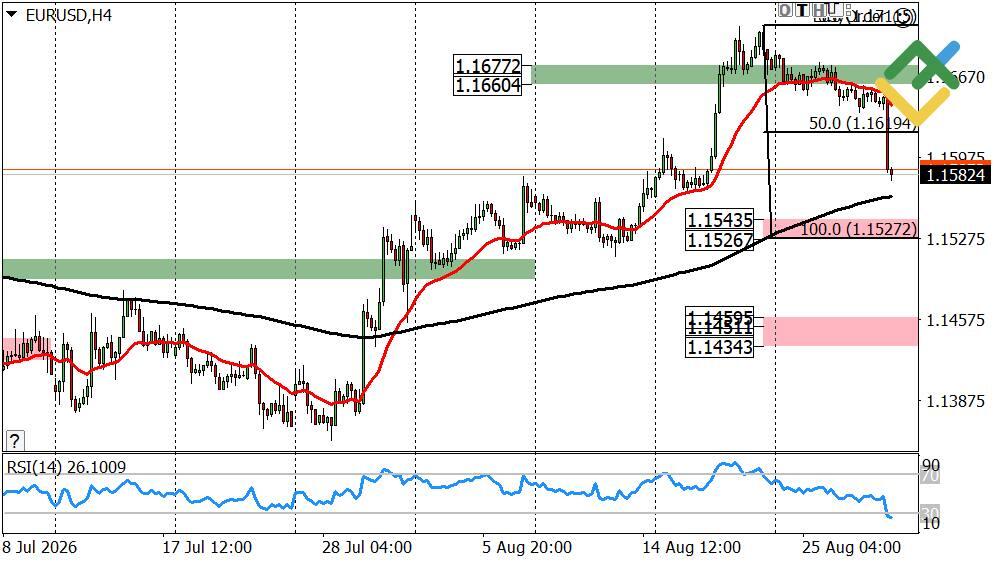
EURUSD Trading Ideas for the Week:
Buy at support A of 1.1543–1.1526. TakeProfit: 1.1619; 1.1711. StopLoss: 1.1483.
Technical analysis based on the margin zones methodology is presented by an independent analyst, Alex Rodionov.
EURUSD Price Forecast for 2026 Based on Technical Analysis
Let's perform a technical analysis of the weekly EURUSD chart to forecast the pair's short-term and long-term movement.
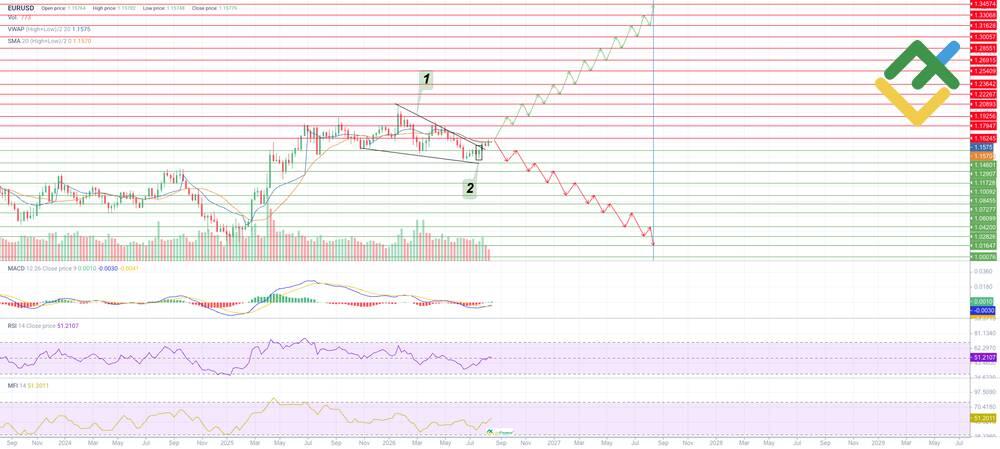
Since late June 2026, the currency pair has been recovering. Technical indicators and candlestick patterns are primarily generating bullish signals:
- The weekly chart shows a large Falling Wedge pattern (1). The price broke above this pattern at 1.1555, likely targeting 1.2089 and above. Within this pattern, a Hammer candlestick pattern (2) has formed near the support level of 1.1460, indicating increased buying activity and signaling a potential rise in the near future.
- MACD is gradually rising in the positive zone, signaling stronger bullish momentum.
- The RSI is also increasing, holding at 51. Upside potential is still present.
- The MFI is growing, indicating an inflow of liquidity.
- The market price is located between the VWAP and the SMA20 line, suggesting a temporary balance of power between bulls and bears.
Below are the projected price levels for EURUSD over the next 12 months:
Month | Minimum, $ | Average, $ | Maximum, $ |
September 2026 | 1.1595 | 1.1753 | 1.1912 |
October 2026 | 1.1757 | 1.1909 | 1.2061 |
November 2026 | 1.1905 | 1.2053 | 1.2202 |
December 2026 | 1.2074 | 1.2202 | 1.2330 |
January 2027 | 1.2256 | 1.2374 | 1.2492 |
February 2027 | 1.2344 | 1.2462 | 1.2580 |
March 2027 | 1.2519 | 1.2630 | 1.2742 |
April 2027 | 1.2573 | 1.2718 | 1.2863 |
May 2027 | 1.2675 | 1.2840 | 1.3005 |
June 2027 | 1.2823 | 1.2981 | 1.3140 |
July 2027 | 1.2971 | 1.3133 | 1.3295 |
August 2027 | 1.3133 | 1.3288 | 1.3444 |
Long-Term Trading Plan for EURUSD for 2026
The technical analysis has revealed key support and resistance levels that can be used for creating a trading strategy for the coming year.
Trading Plan for the Year
- The price is likely to continue rising in the near future.
- Key support levels: 1.1460, 1.1290, 1.1172, 1.1009, 1.0845, 1.0727, 1.0609, 1.0420, 1.0282, 1.0164, and 1.0007.
- Key resistance levels: 1.1624, 1.1794, 1.1925, 1.2089, 1.2226, 1.2364, 1.2540, 1.2691, 1.2855, 1.3005, 1.3162, 1.3306, and 1.3457.
- Base long-term scenario: Open long trades above the key resistance level of 1.1624 on increased volume, with short-term targets around 1.1794–1.2089 and above 1.2226, and medium-term targets in the 1.2364–1.3457 range. Time horizon: 12 months.
- Alternative long-term scenario: Open short trades below the key support level of 1.1460, targeting 1.1290–1.0007.
Analysts' EURUSD Price Projections for 2026
Analysts' views on the performance of the EURUSD pair in the second half of 2026 differ. Some expect a moderate increase to $1.1700 by year-end amid the eurozone's economic recovery. Others anticipate a decline to $1.1500–$1.1460.
LongForecast
Price range: $1.1290–$1.1960.
LongForecast expects the EURUSD pair to close at $1.1620 in August, climb to $1.1770 in October, and then decline in November, eventually reaching $1.1460 in December.
Month | Open, $ | Min–Max, $ | Close, $ |
August | 1.1530 | 1.1430–1.1810 | 1.1620 |
September | 1.1620 | 1.1450–1.1960 | 1.1660 |
October | 1.1660 | 1.1590–1.1950 | 1.1770 |
November | 1.1770 | 1.1370–1.1770 | 1.1540 |
December | 1.1540 | 1.1290–1.1630 | 1.1460 |
WalletInvestor
Price range: $1.1000–$1.1900.
WalletInvestor forecasts a predominantly bearish trend for the EURUSD pair in the second half of 2026. The average value is expected to reach $1.1700 in August, drop to $1.1400 in October, and partially recover to $1.1500 in December.
Month | Minimum, $ | Average, $ | Maximum, $ |
August | 1.1500 | 1.1700 | 1.1700 |
September | 1.1400 | 1.1500 | 1.1800 |
October | 1.1000 | 1.1400 | 1.1700 |
November | 1.1300 | 1.1500 | 1.1800 |
December | 1.1200 | 1.1500 | 1.1900 |
CoinCodex
Price range: $1.1600–$1.1900.
CoinCodex believes the EURUSD pair will trade between $1.1600 and $1.1700 in August, averaging around $1.1600. The average value is projected to advance to $1.1800 in November, then decline to $1.1700 in December.
Month | Minimum, $ | Average, $ | Maximum, $ |
August | 1.1600 | 1.1600 | 1.1700 |
September | 1.1600 | 1.1700 | 1.1800 |
October | 1.1600 | 1.1700 | 1.1800 |
November | 1.1800 | 1.1800 | 1.1900 |
December | 1.1600 | 1.1700 | 1.1900 |
Analysts' EURUSD Price Projections for 2027
Forecasts for the EURUSD pair in 2027 vary widely. The pair's movement will depend on the geopolitical situation, interest rates, and the state of the eurozone and US economies. According to experts, the pair may trade between $1.0600 and $1.2300.
Note: The price ranges reflect the asset's expected volatility throughout the year. Lows and highs may not be shown in the summary tables.
LongForecast
Price range: $1.1180–$1.1960.
LongForecast predicts that the EURUSD pair will trade between $1.1180 and $1.1810 in Q1 2027 and rebound to $1.1660 by mid-year. The uptrend may continue in the second half of the year, pushing the pair to $1.1780 by December.
Quarter | Open, $ | Min–Max, $ | Close, $ |
Q1 | 1.1460 | 1.1180–1.1810 | 1.1350 |
Q2 | 1.1350 | 1.1280–1.1830 | 1.1660 |
Q3 | 1.1660 | 1.1290–1.1960 | 1.1780 |
Q4 | 1.1780 | 1.1260–1.1960 | 1.1780 |
WalletInvestor
Price range: $1.1100–$1.2300.
Analysts at WalletInvestor estimate that the average value of the EURUSD pair will stay around $1.1700 during the first three quarters of 2027. In December, a modest increase to $1.1800 is expected.
Quarter | Minimum, $ | Average, $ | Maximum, $ |
Q1 | 1.1300 | 1.1700 | 1.2100 |
Q2 | 1.1100 | 1.1700 | 1.2000 |
Q3 | 1.1300 | 1.1700 | 1.2100 |
Q4 | 1.1300 | 1.1800 | 1.2300 |
CoinCodex
Price range: $1.0600–$1.1800.
According to CoinCodex, the EURUSD pair will stabilize around $1.1500 in the first half of 2027. After that, the asset is predicted to turn downward, reaching $1.0800 in December.
Quarter | Minimum, $ | Average, $ | Maximum, $ |
Q1 | 1.1400 | 1.1500 | 1.1800 |
Q2 | 1.1300 | 1.1500 | 1.1800 |
Q3 | 1.1300 | 1.1400 | 1.1600 |
Q4 | 1.0600 | 1.0800 | 1.1500 |
Analysts' EURUSD Price Projections for 2028
The outlook for the EURUSD pair in 2028 remains uncertain. The state of the eurozone and US economies, the development of new technologies, climate change, and demographic trends may all affect the exchange rate. Optimistic estimates suggest the pair may reach $1.2100–$1.2150 in December, while more conservative forecasts point to $1.1600.
LongForecast
Price range: $1.1470–$1.2710.
LongForecast expects the EURUSD pair to appreciate in 2028. The exchange rate is projected to trade around $1.1780 in January and move up to $1.1910 by June. In the second half of the year, the uptrend is likely to extend, driving the price to $1.2150 by December.
Quarter | Open, $ | Min–Max, $ | Close, $ |
Q1 | 1.1780 | 1.1780–1.2700 | 1.2510 |
Q2 | 1.2510 | 1.1730–1.2710 | 1.1910 |
Q3 | 1.1910 | 1.1470–1.2150 | 1.1970 |
Q4 | 1.1970 | 1.1770–1.2330 | 1.2150 |
WalletInvestor
Price range: $1.0900–$1.2400.
According to WalletInvestor, the EURUSD pair will trade unevenly in 2028. The asset is expected to reach $1.1600 in January, climb to $1.1800 by mid-year, and then retreat to around $1.1600 in December.
Quarter | Minimum, $ | Average, $ | Maximum, $ |
Q1 | 1.1200 | 1.1600 | 1.2300 |
Q2 | 1.1200 | 1.1800 | 1.2400 |
Q3 | 1.1200 | 1.1900 | 1.2400 |
Q4 | 1.0900 | 1.1600 | 1.2100 |
CoinCodex
Price range: $1.0600–$1.2300.
CoinCodex predicts that the euro will strengthen against the US dollar in 2028. The average price is expected to settle at $1.0900 in Q1 and increase to $1.1500 by mid-year. In the second half of the year, the uptrend is likely to carry on, with the price hitting $1.2100 by December.
Quarter | Minimum, $ | Average, $ | Maximum, $ |
Q1 | 1.0600 | 1.0900 | 1.1100 |
Q2 | 1.0800 | 1.1500 | 1.1700 |
Q3 | 1.1600 | 1.2200 | 1.2300 |
Q4 | 1.1800 | 1.2100 | 1.2300 |
Analysts' EURUSD Price Projections for 2029
Forecasts for the EURUSD pair in 2029 are highly tentative due to the long-term nature of the forecast. The pair's performance may be influenced by global economic shocks, political instability, and other fundamental factors. The base scenario projects the pair to trade within the range of $1.1500–$1.1770.
LongForecast
Price range: $1.1570–$1.2450.
LongForecast estimates that the EURUSD pair may open at $1.2150 in 2029. After that, the exchange rate is predicted to fluctuate, eventually plunging to $1.1770 in December.
Quarter | Open, $ | Min–Max, $ | Close, $ |
Q1 | 1.2150 | 1.1810–1.2190 | 1.1990 |
Q2 | 1.1990 | 1.1570–1.2440 | 1.2260 |
Q3 | 1.2260 | 1.1610–1.2450 | 1.1790 |
Q4 | 1.1790 | 1.1590–1.2310 | 1.1770 |
WalletInvestor
Price range: $1.1000–$1.2700.
WalletInvestor suggests that the average EURUSD value will stay around $1.1800 during the first three quarters of 2029. However, in the final months of the year, the pair is projected to decrease, reaching $1.1500 by December.
Quarter | Minimum, $ | Average, $ | Maximum, $ |
Q1 | 1.1100 | 1.1800 | 1.2400 |
Q2 | 1.1000 | 1.1800 | 1.2500 |
Q3 | 1.1200 | 1.1800 | 1.2500 |
Q4 | 1.1000 | 1.1500 | 1.2700 |
CoinCodex
Price range: $1.1500–$1.2800.
CoinCodex assumes that the EURUSD pair will weaken throughout most of 2029. After reaching $1.2600 in Q1, the average value could fall to $1.1900 in June. In the second half of the year, the decline is expected to continue, with the price potentially reaching $1.1600 by December.
Quarter | Minimum, $ | Average, $ | Maximum, $ |
Q1 | 1.2200 | 1.2600 | 1.2800 |
Q2 | 1.1800 | 1.1900 | 1.2700 |
Q3 | 1.1600 | 1.1900 | 1.2000 |
Q4 | 1.1500 | 1.1600 | 1.1800 |
Analysts' EURUSD Price Projections for 2030
Forecasts for 2030 are also highly uncertain. The health of the global economy, technological changes, and geopolitical events may all impact the EURUSD pair. Therefore, estimates vary widely, ranging from $0.9663 to $1.2900.
WalletInvestor
Price range: $1.0800–$1.2900.
According to WalletInvestor, the EURUSD pair may show mixed trends in 2030. The average value is expected to reach $1.2000 in Q1, then drop to $1.1700 by June. In the remaining months, the pair will likely rebound, reaching $1.1900 in December.
Quarter | Minimum, $ | Average, $ | Maximum, $ |
Q1 | 1.1300 | 1.2000 | 1.2900 |
Q2 | 1.1000 | 1.1700 | 1.2700 |
Q3 | 1.1000 | 1.1800 | 1.2600 |
Q4 | 1.0800 | 1.1900 | 1.2600 |
CoinCodex
Price range: $1.1100–$1.1800.
CoinCodex does not predict any pronounced trends for 2030. The average value of the EURUSD pair is projected to hover around $1.1500 in the first half of the year. Afterward, minor fluctuations are expected. In December, the pair is expected to settle around $1.1400.
Quarter | Minimum, $ | Average, $ | Maximum, $ |
Q1 | 1.1400 | 1.1500 | 1.1800 |
Q2 | 1.1400 | 1.1500 | 1.1600 |
Q3 | 1.1100 | 1.1200 | 1.1500 |
Q4 | 1.1200 | 1.1400 | 1.1500 |
Gov Capital
Price range: $0.9663–$1.2571.
Gov Capital points to a gradual weakening of the EURUSD pair in 2030. The asset is expected to reach $1.1238 in Q1 and decline to $1.1205 by June. The downtrend is likely to continue in the second half of the year, bringing the pair down to $1.0790 by December.
Quarter | Minimum, $ | Average, $ | Maximum, $ |
Q1 | 1.0082 | 1.1238 | 1.2520 |
Q2 | 1.0046 | 1.1205 | 1.2571 |
Q3 | 0.9943 | 1.1138 | 1.2371 |
Q4 | 0.9663 | 1.0790 | 1.2271 |
Analysts' EURUSD Price Projections until 2050
It is practically impossible to make a reliable forecast for 15–25 years into the future. Over that time, the global economy, politics, and technology may change significantly, so the accuracy of any long-term estimates remains low.
The EURUSD pair can be influenced by inflation, employment, economic growth rates, and monetary policy in the Eurozone and the US. These factors cannot be predicted decades in advance. Geopolitical conflicts, changes in international trade, and technological advances add to the uncertainty.
Moreover, the structure of the global financial system may change during this period. For example, other reserve currencies may gain ground, or new payment and financial instruments may emerge.
Therefore, projections for 2040–2050 should be viewed only as possible scenarios, not as precise forecasts.
EURUSD Market Sentiment on Social Media
Media sentiment reflects traders' and investors' overall attitude toward the EURUSD pair, based on social media posts and discussions. Analyzing the tone of these messages helps determine which sentiments prevail in the market: positive, negative, or neutral.
However, sentiment should not be considered a standalone signal for forecasting exchange rates. Market sentiment may influence price movements, but its impact depends on the time frame and other market factors.
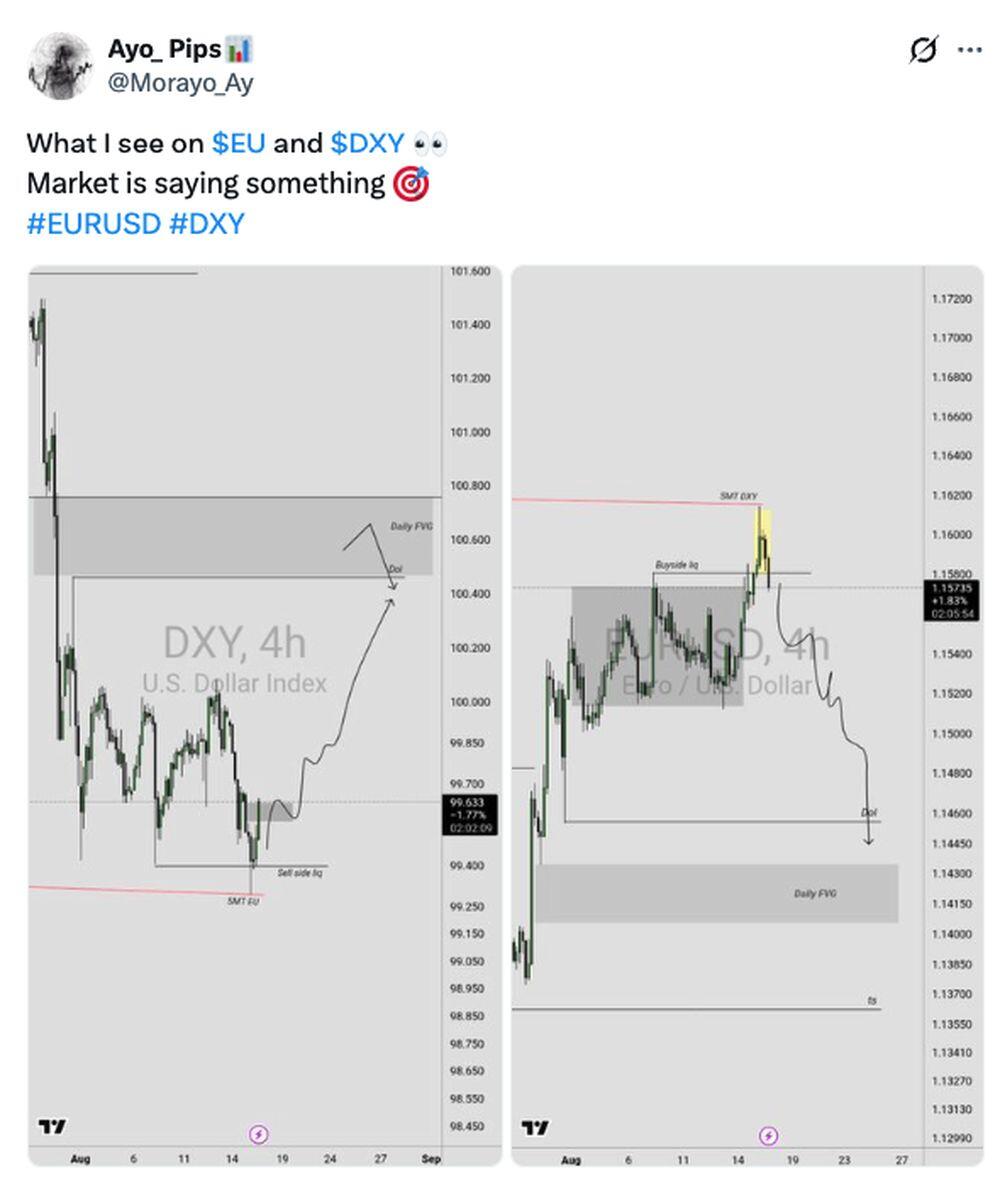
For example, user @Morayo_Ay predicts on X (formerly Twitter) that the EURUSD pair will fall to $1.1460 in the short term.
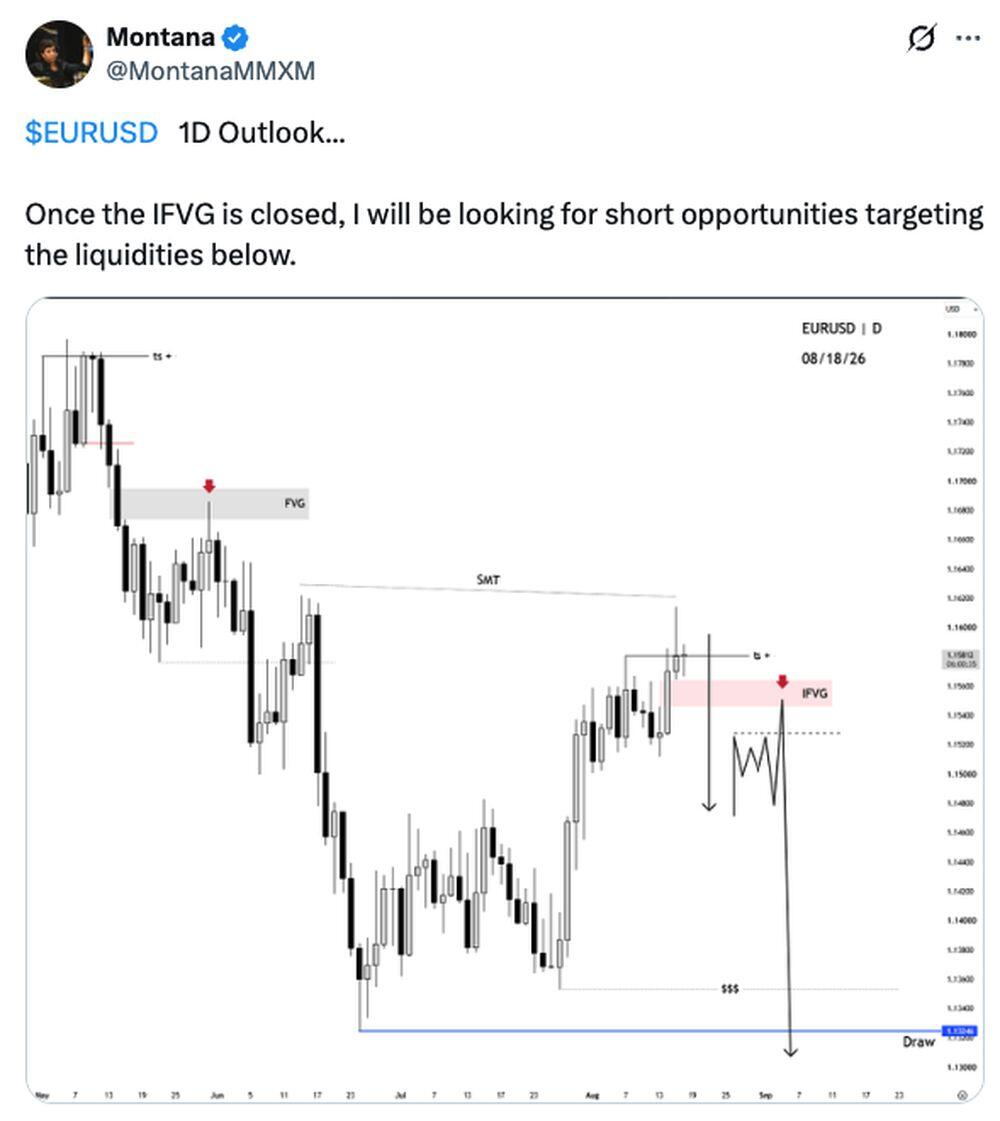
Expert @MontanaMMXM forecasts the EURUSD pair to decline to $1.1324 in the near future.
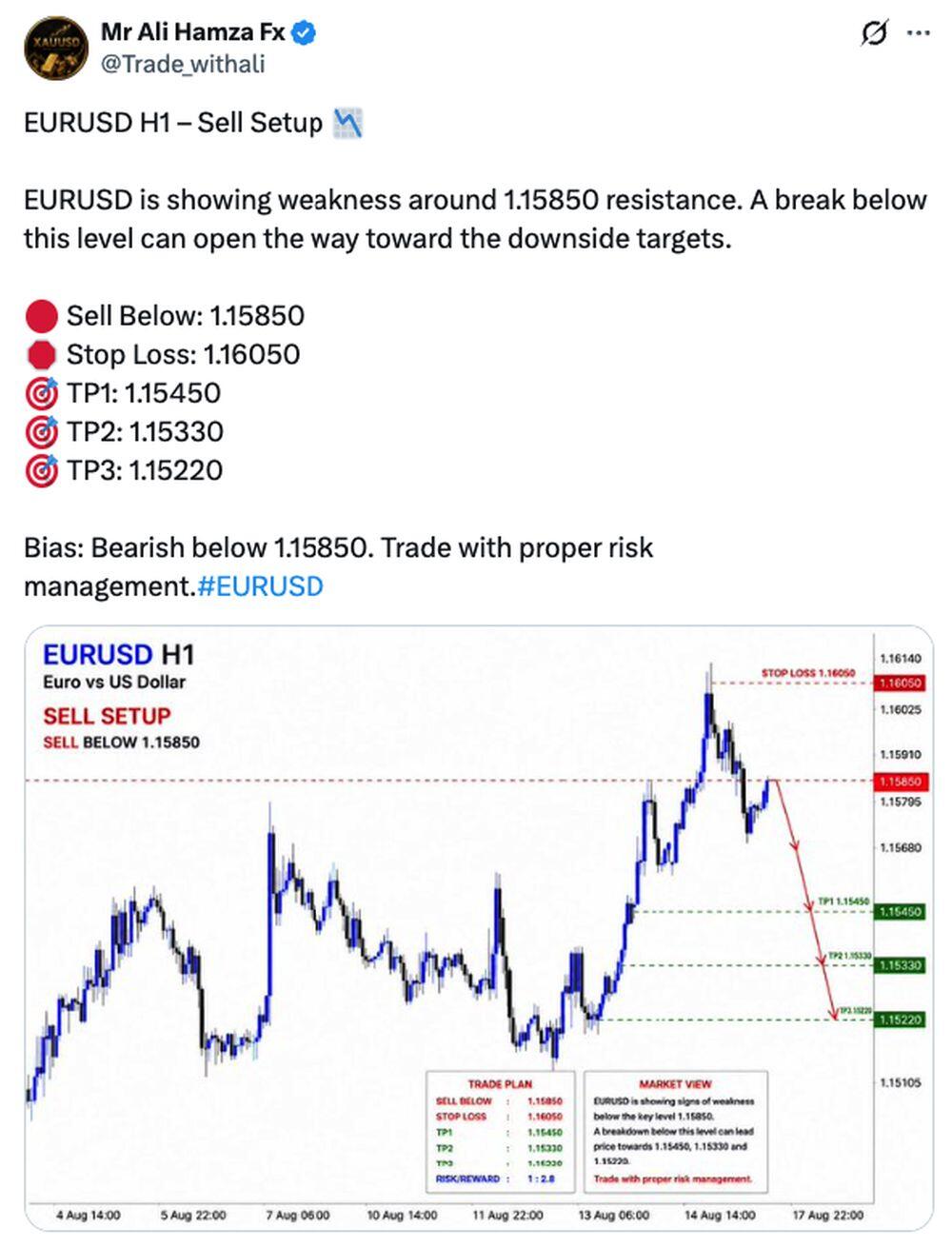
Trader @Trade_withali anticipates a decrease in the EURUSD pair to $1.1522.
The analysis of posts on the social media platform X shows that users are mostly bearish on the future movement of the EURUSD pair.
EURUSD Price History
The EURUSD pair reached its all-time high of $1.6039 on 15.07.2008. The lowest price of the EURUSD pair was recorded on 26.10.2000 and reached $0.8227.
To make our forecasts as accurate as possible, it is crucial to evaluate historical data. The chart below shows EURUSD's performance over the last ten years.
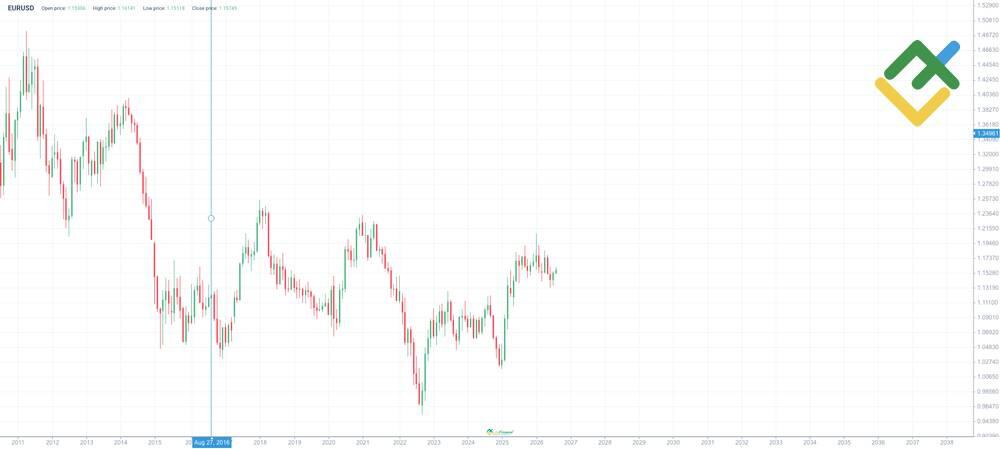
- Between 2002 and 2008, the pair was trading within an upward trend, reaching 1.60 against a weak US dollar and the strengthened EU economy.
- Following 2008, the exchange rate began to slide. The eurozone's financial crisis led to a further decline, reaching 1.20–1.25.
- Between 2014 and 2020, the euro faced headwinds due to the European Central Bank's (ECB) low interest rates and stimulus policies.
- In 2020–2021, the EURUSD rate surged to 1.23, reacting to the Fed's accommodating policy and the post-pandemic recovery.
- In 2022, the pair slipped below parity amid aggressive rate hikes in the US and the EU financial crisis.
- Since 2023, the EURUSD pair has stabilized within the 1.05–1.10 range.
- In 2025, the EURUSD pair was highly volatile due to monetary policy changes by the ECB and the Fed. In the first half of the year, the euro strengthened to 1.18. In the second half, the pair traded in a wide range of 1.13–1.19, reaching 1.17 in December.
- In January 2026, the euro strengthened to 1.2082, fueled by the Fed's monetary policy easing. The pair then fell to 1.1410 by mid-March. In April, it began to recover and reached a swing high before reversing and moving lower. Over the summer, EURUSD rebounded and approached 1.16 in August.
EURUSD Price Fundamental Analysis
Fundamental analysis provides the context necessary to understand what causes the EURUSD to move in one direction or another. In contrast to the technical approach, fundamental analysis relies on economic and political data that reflect the actual state of the US and eurozone economies. These indicators influence market participants' expectations, shaping long-term trends for the EURUSD currency pair.
What Factors Affect the EURUSD Pair?
The EUR/USD pair is sensitive to the following key macroeconomic indicators:
- Fed and ECB interest rates.
- Inflation rates in the US and the eurozone.
- Gross domestic product (GDP) growth rates.
- Unemployment rates.
- Political stability and geopolitical factors.
- Trade balance.
- Speeches by central bank officials.
- Market expectations on monetary policy.
- US–EU bond yield spread.
- Global risk appetite and demand for the US dollar as a safe-haven asset.
These factors have the potential to strengthen or weaken the euro and the US dollar, leading to short-term fluctuations or stable market trends.
More Facts About EURUSD
The EURUSD pair is the world's most traded trading instrument on Forex, reflecting the ratio of the euro (the currency of the eurozone) to the US dollar. It attracts both speculative traders and long-term investors.
This pair is characterized by high liquidity, narrow spreads, and quick reaction to macroeconomic news. This pair is particularly sensitive to macroeconomic data, including interest rates, inflation, GDP, and employment data. The decisions of the European Central Bank and the US Federal Reserve directly impact the EURUSD rate.
Meanwhile, the EURUSD pair is exposed to global risks. In times of uncertainty, the US dollar strengthens as a protective asset, while in times of economic recovery, the euro can grow.
Analyzing this pair requires a multifaceted approach, incorporating a fundamental focus on economic indicators, technical analysis to identify entry and exit points, and ongoing monitoring of market sentiment. Such a comprehensive approach makes the EURUSD pair a crucial barometer of global financial health.
Advantages and Disadvantages of Investing in EURUSD
The EURUSD is the most liquid currency pair in the Forex market, suitable for short-term speculation and long-term investment. However, like any instrument, it has its pros and cons.
Advantages
- High liquidity and narrow spreads.
- Round-the-clock trading.
- Wide range of analytical tools and forecasts.
- Offered by many trading platforms and brokers.
- The pair is well studied and predictable in a stable market.
- High sensitivity to economic news, creating opportunities for trading on news.
Disadvantages
- High volatility when macroeconomic data is released.
- Dependence on central bank policies and geopolitical factors.
- Requires a deep understanding of macroeconomic factors.
- Strongly influenced by external factors, not always predictable.
- False signals in case of increased speculative activity.
- Lack of a sustainable trend in a flat market.
The EURUSD pair continues to be regarded as an appealing investment due to its clarity and accessibility. However, it is essential to exercise caution and always conduct thorough technical and fundamental analyses.
How We Make Forecasts
Our forecasts are based on a combination of technical and fundamental analysis.
- For short-term forecasts for several days to a week, a technical analysis is used. It involves studying price patterns, support and resistance levels, MACD, RSI, and moving averages, as well as analyzing price behavior on different time frames.
- Medium-term forecasts for 1–3 months rely on macroeconomic indicators, interest rates, inflation, and central bank decisions.
- Long-term forecasts extending over a period of 6–24 months are informed by economic cycles, geopolitical factors, and global market trends. The seasonal patterns, historical levels, and the perspectives of reputable investment funds are integral to the refinement of these forecasts.
Such a comprehensive approach enables us to assess the current price movement and the future trajectory of the analyzed currency pair.
Conclusion: Is EURUSD a Good Investment?
Trading the EURUSD pair involves significant risk and requires a solid grasp of market conditions. This instrument is better suited for intraday traders rather than long-term investors. The pair's exchange rate is determined by the strength of the EU and US economies. The pair is demonstrating increased volatility amid the current instability and uncertainty in monetary policy.
To trade the EURUSD pair successfully, you need to carefully analyze short-term data, as it changes almost daily. Therefore, this pair is better suited for active trading rather than for preserving or growing your capital.
EURUSD Price Prediction FAQs
The current price of the EURUSD pair is $1.15936 as of 02.09.2026.
EURUSD is trading around $1.1578 without clear direction. Expectations for ECB and Fed policies, along with economic data from the Eurozone and the US, are influencing the exchange rate. The pair is expected to trade sideways with a moderate downward bias in the short term.
The weakening of the euro against the US dollar may be linked to a stronger dollar, the Fed's tight monetary policy, geopolitical risks, and weak economic indicators in the eurozone.
The outlook for the EURUSD pair depends primarily on interest rates, the state of the eurozone and US economies, inflation, and the geopolitical situation. Based on the predictions, the asset may trade between $1.1460 and $1.1500 in December 2026, although some forecasting platforms suggest higher levels.
There is no consensus on the outlook for 2026. Some analysts anticipate the euro will strengthen to $1.1700 against the dollar. Others expect a decline to $1.1460–$1.1500. The direction will largely depend on macroeconomic indicators and decisions by the ECB and the Fed.
The range of estimates for 2027 is significantly wider. Depending on the scenario, the pair may trade between $1.0600 and $1.2300. The longer the forecast horizon, the greater the uncertainty, and the more the outcome depends on economic and political factors.
There is no definitive answer, as it depends on your goals, strategy, risk tolerance, and trading horizon. Before opening a position, consider current market conditions, macroeconomic data, and technical signals instead of relying solely on analysts' forecasts.
The future direction of EURUSD will largely depend on ECB and Fed interest rate decisions. Inflation, employment, and economic growth data will also play an important role. If the Fed adopts a more hawkish stance than the ECB, the dollar could strengthen, putting pressure on the euro.
The EURUSD exchange rate is shaped by interest rate differentials, inflation, macroeconomic data, central bank actions, and the overall sentiment in global financial markets.
Price chart of EURUSD in real time mode
The content of this article reflects the author’s opinion and does not necessarily reflect the official position of LiteFinance broker. The material published on this page is provided for informational purposes only and should not be considered as the provision of investment advice for the purposes of Directive 2014/65/EU.
According to copyright law, this article is considered intellectual property, which includes a prohibition on copying and distributing it without consent.